Why does the Reserve Bank make home loans more expensive when groceries, petrol, and electricity are already costing us more?
Imagine this: you visit the supermarket and your regular grocery basket costs $250 instead of $220. Petrol is elevated. Your quarterly power bill has jumped. Then you hear on the evening news that the Reserve Bank of Australia (RBA) has increased the official cash rate again.
If you have a variable home loan or commercial mortgage, your immediate reaction is understandable:
The Fair Question: “How does making my monthly home loan repayment more expensive fix the price of groceries and fuel at the checkout?”
The short answer: Higher interest rates can slow inflation when excessive borrowing and aggregate spending are pushing prices up. But they cannot directly produce more houses, grow more food, or lower world crude oil prices. Whether an RBA rate hike is helpful depends on what is causing inflation, how long that shock might last, and what happens to household budgets and jobs along the way.
#1. What's Happening in Australia Right Now?
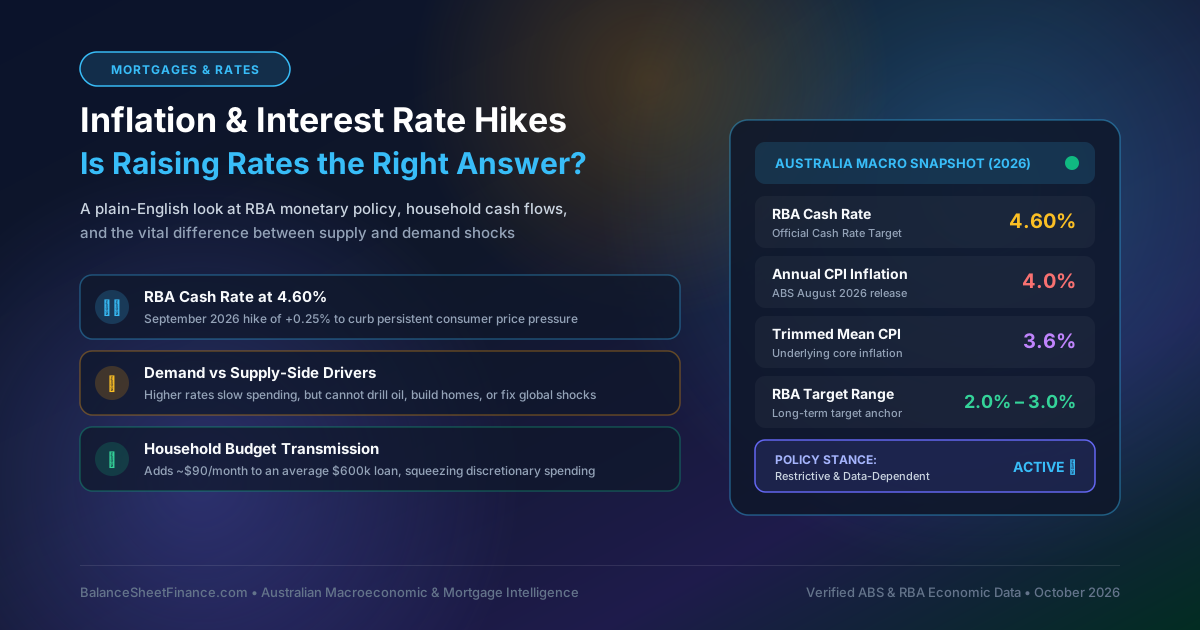
As of October 2026, the key Australian macroeconomic figures stand at:
| Measure | Latest Figure | What It Means |
|---|---|---|
| RBA Cash Rate | 4.60% | The benchmark rate used by the RBA to influence commercial borrowing, lending, and deposit rates |
| Annual CPI Inflation (August 2026) | 4.0% | Average consumer prices across Australian capital cities were 4% higher than 12 months earlier |
| Underlying Inflation (Trimmed Mean) | 3.6% | Core inflation metric designed to filter out temporary price volatility and show underlying momentum |
| RBA Inflation Target | 2.0% – 3.0% | The medium-term target band the Reserve Bank is legislated to achieve on average over time |
The RBA raised the cash rate by 0.25 percentage points on 29 September 2026, citing both resilient domestic demand and upward international energy pressures.
Sources: RBA September Monetary Policy Decision, RBA Cash Rate Target Overview, and ABS Consumer Price Index Release.
#2. What Is Inflation? Let's Use a Shopping Basket
Inflation simply means prices, on average, are rising across the economy.
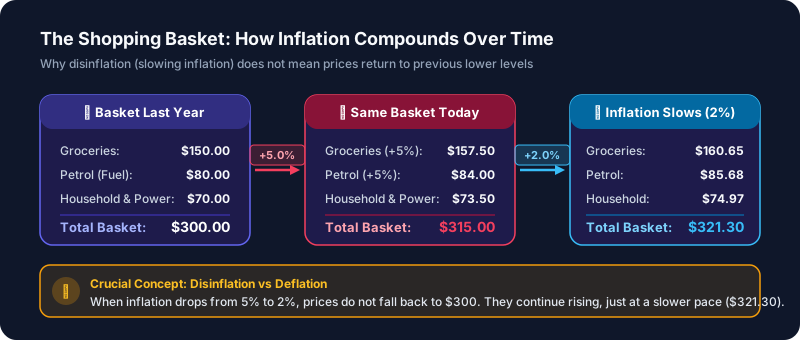
To understand how economists measure it, imagine your typical weekly household shopping basket:
| Item | Last Year | This Year | Net Difference |
|---|---|---|---|
| Groceries | $150 | $158 | +$8.00 |
| Petrol | $80 | $84 | +$4.00 |
| Household & Utilities | $70 | $73 | +$3.00 |
| Total Weekly Basket | $300 | $315 | +$15.00 (+5.0%) |
This illustration shows prices rising 5% overall. Your original $300 now purchases noticeably fewer goods and services than it did twelve months prior.
Crucial Concept: Inflation falling does not mean prices fall! If annual inflation cools from 5% to 2%, prices are still rising — just at a slower rate ($315 to $321.30, rather than dropping back to $300).
#3. Why Does the RBA Raise Interest Rates?
Think of the Australian economy like a busy weekend farmer's market.
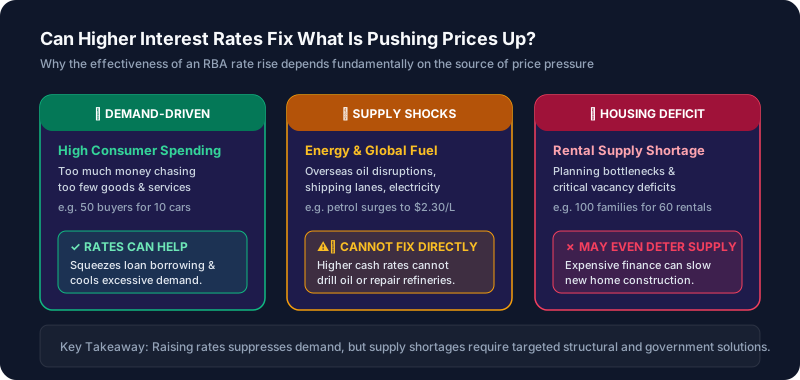
If dozens of eager customers arrive with full pockets competing for a limited supply of produce, stallholders quickly realize they can mark up prices without losing sales. This is known as demand-driven inflation: too much money chasing too few goods and services.
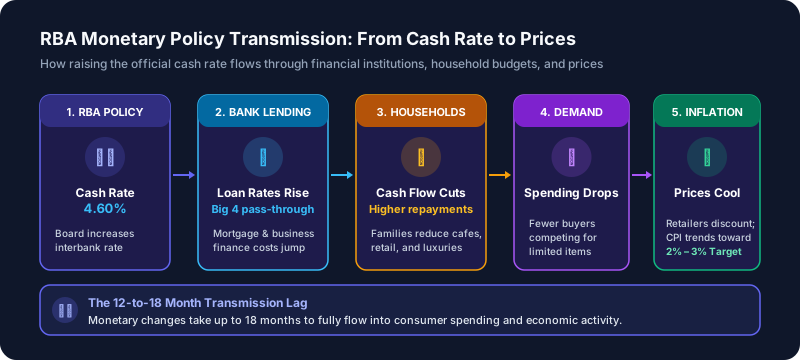
When the Reserve Bank increases the cash rate, a clear 5-stage chain reaction takes place:
- Borrowing costs rise: Commercial banks pass rate hikes onto variable mortgages, personal credit lines, and business overdrafts.
- New debt becomes dearer: Fewer people take out maximum mortgages or finance new vehicles.
- Discretionary spending shrinks: Households redirect funds toward monthly mortgage repayments, leaving less for dining out, travel, and non-essentials.
- Aggregate demand cools: Foot traffic and customer spending in retail stores and hospitality venues slow down.
- Price increases decelerate: Businesses can no longer pass through aggressive price hikes and must discount to compete for customers.
Everyday Example: Imagine 50 eager buyers competing for only 10 brand-new cars on a showroom floor. Dealerships have zero incentive to negotiate. But if higher interest rates cause 30 buyers to delay their upgrade, dealers suddenly have to compete on drive-away price and discounts to attract the remaining 20 buyers.
#4. But Not All Inflation Has the Same Cause
This is where the economic debate becomes critical for policymakers and families alike. Not all price surges originate from excess customer spending.
| What Is Pushing Prices Up? | Everyday Example | Can Higher Interest Rates Fix the Problem? |
|---|---|---|
| Strong Consumer Demand | Too many buyers competing for scarce cars or flights | Can Help: Reduces borrowing and reins in discretionary cash flow |
| Supply Shortage | Severe shortfall of rental housing and completed apartments | Not Directly: Higher rates do not pour concrete or build houses |
| Imported Price Shocks | Global oil disruptions and shipping container bottlenecks | Not Directly: Raising Australian rates cannot drill more crude oil |
| Higher Energy and Fuel Costs | Commercial transport and manufacturing electricity bills rise | Limited: Cools downstream demand, but cannot erase input fuel costs |
| Inflation Expectations | Businesses and workers expect ongoing high inflation and build it into contracts | Can Help: Anchors expectations and prevents a wage-price spiral |
The RBA itself acknowledges that temporary supply shocks and persistent demand-driven inflation require different policy consideration, and that cash-rate shifts carry long operational lags.
#Example A: International Oil and Fuel Surges
Suppose geopolitical disruption pushes international crude oil up, sending Melbourne and Sydney unleaded petrol from $1.80 to $2.30 per litre.
A commuter buying 50 litres weekly now pays $25 more each week. Raising the Australian cash rate cannot resolve overseas pipeline bottlenecks or repair refineries. However, the central bank worries that sustained high fuel costs will cascade into supermarket trucking fees, delivery costs, and long-term inflation psychology.
#Example B: The Rental Housing Shortage
Imagine an Australian suburb where 100 tenant families are seeking homes, but only 60 rental properties are listed.
Rents surge because of an acute physical shortage of dwellings. Higher mortgage interest rates do not construct the missing 40 apartments. In fact, elevated borrowing costs and tight lending criteria can discourage residential developers and builders from initiating new multi-unit developments.
This is why structural housing challenges require planning, tax, and supply-side reforms — not solely interest rate blunt tools.
#5. Who Feels a Rate Increase Most?
The monetary policy lever does not impact all Australians equally. It distributes financial pressure unevenly across sectors:
| Household or Business Group | Primary Impact of Higher Rates |
|---|---|
| Family with a Variable-Rate Mortgage | Monthly repayments climb immediately; discretionary income contracts |
| Renter | No direct loan repayment, but may face rent increases if landlords attempt to pass on borrowing costs in tight markets |
| Retiree with Cash Deposits | Receives higher term deposit returns and cash savings interest income |
| First-Home Buyer | Maximum borrowing capacity drops significantly, shrinking purchasing budgets |
| Small Business with Equipment Debt | Monthly finance charges expand while consumer foot traffic moderates |
| Fixed-Rate Mortgage Holder | Insulated until the fixed period expires, followed by a sudden repayment cliff |
#Real-World Example: A $600,000 Australian Mortgage
Consider a homeowner with $600,000 outstanding debt, with 25 years remaining, experiencing a 0.25% rate increase from 5.50% to 5.75%:
| Loan Parameter | Before Rate Hike | After 0.25% Hike | Difference |
|---|---|---|---|
| Home Loan Interest Rate | 5.50% | 5.75% | +0.25% |
| Approx. Monthly Repayment | $3,685 | $3,775 | +$90 / month |
| Extra Annual Cash Outflow | — | — | +$1,080 / year |
(Illustration based on a standard principal-and-interest mortgage over 25 years. Actual lender comparison figures vary).
A household forced to allocate an additional $90 each month to debt service cuts back on cafes, holidays, and homewares. That contraction is precisely how rate hikes slow aggregate demand. But when that same household also faces higher power bills and grocery receipts, the cumulative strain is substantial.
Proactive Portfolio Tip: Property owners can compare current commercial lender rates across the Big 4 banks via the BalanceSheet Bank Rates Directory to verify whether their current loan is competitive or eligible for refinancing discounts.
#6. Is Raising Interest Rates the Right Approach?
Economists and policymakers weigh two compelling perspectives:
#The Case for Raising Rates
- Preserving Purchasing Power: Unchecked high inflation permanently erodes the purchasing value of cash savings, wages, and superannuation.
- Breaking Inflation Psychology: If businesses and unions expect prices to jump 5% annually, they adjust prices and wage demands upward, creating a self-fulfilling spiral.
- Proven Macroeconomic Tool: The official cash rate can be adjusted and deployed relatively quickly compared to legislative tax reforms.
#The Case for Restraint
- Disproportionate Burden: Rate hikes target indebted mortgage holders and businesses while leaving debt-free households largely unaffected.
- Supply Inelasticity: Higher rates cannot build timber frames, pump gas, or ease shipping bottlenecks.
- Economic Slowdown Risk: Because monetary policy takes 12 to 18 months to fully bite, tightening too fast risks pushing the domestic economy into unnecessary job losses and stagnation.
The essential question is not simply “should the RBA hike or pause?” It is “what specific type of inflation are we fighting, and how much economic slowing is prudent?”
#7. What Else Should the RBA Weigh?
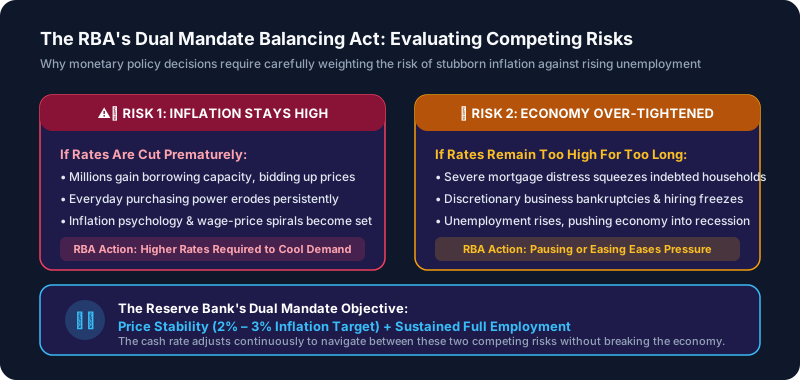
The Reserve Bank of Australia operates under a Dual Mandate:
- Price Stability: Keeping consumer inflation anchored within the 2% to 3% target band.
- Sustained Full Employment: Fostering an economy where all Australians seeking employment can find work without generating unsustainable wage pressure.
Key indicators monitored alongside headline inflation include:
| Macroeconomic Indicator | What It Reveals | Core Policy Question |
|---|---|---|
| Unemployment and Job Vacancies | Health of the national labour market | Are job openings falling and layoffs starting to rise? |
| Wage Price Index (WPI) | Real income growth trajectory | Are salary increases outpacing national productivity gains? |
| Household Savings Ratio | Buffer reserves of Australian families | Have households exhausted pandemic savings cushions? |
| Housing Approvals and Starts | Future dwelling supply pipeline | Are high lending rates halting new residential construction? |
| Global Commodity and Energy Prices | International trade shocks | Are global oil or freight shocks driving domestic CPI? |
| Monetary Policy Lag | Full impact of previous rate cycles | Has enough time elapsed to assess the impact of earlier hikes? |
#8. What Else Can Australia Do Beyond Interest Rates?
The RBA manages monetary policy, but many of the most effective long-term solutions lie with Federal and State Governments, regulatory agencies, and the private sector:
| Core Challenge | Structural Government and Industry Action | Key Trade-Off to Manage |
|---|---|---|
| Housing Deficit | Streamline planning approvals, unlock land, and support social housing | Construction takes years to deliver physical keys |
| Energy and Power Spikes | Expand domestic energy supply, upgrade grids, and invest in efficiency | Capital-intensive long-term infrastructure investment |
| Supply Chain Snarls | Modernize logistics, domestic manufacturing, and transport corridors | Cannot insulate against every overseas geopolitical shock |
| Cost of Living Relief | Deliver targeted energy rebates to low-income and vulnerable households | Untargeted cash splashes can inadvertently stimulate demand |
| Market Concentration | Empower the ACCC to investigate price gouging and boost retail competition | Regulatory enforcement takes substantial court time |
| Workforce Shortages | Fund targeted TAFE skills training and streamline skilled migration | Takes time for newly trained workers to enter the market |
#9. Why Can't the RBA Simply Lower Rates to Help Families?
If mortgage holders are under financial pressure, why doesn't the Reserve Bank immediately reduce the cash rate by 1.00% to provide mortgage relief?
If millions of Australian households suddenly received $300 to $500 more monthly disposable cash, aggregate spending would rebound immediately. With the same limited supply of rental homes, goods, and services, businesses would respond to swelling demand by marking up prices. Inflation would reignite.
That is the delicate tightrope the RBA must walk:
#10. A Simple Thought Experiment: Three Australian Towns
Consider three distinct Australian communities, each recording identical 4.0% inflation:
| Community | What Is Happening on the Ground? | What Policy Response Matters Most? |
|---|---|---|
| Busy Bay | Retail precincts are packed; employers cannot hire enough staff to fill orders | Cash Rate Hikes Help: Slowing excessive demand brings balance |
| Oil Creek | A sudden global shipping disruption has doubled diesel and delivery freight | Rate Hikes Have Limited Effect: Shock requires supply resilience |
| Housing Hills | An acute housing deficit has triggered double-digit residential rent spikes | Supply Reform Needed: Planning and construction incentives required |
The Same 4.0% Headline Number. Three Completely Different Causes.
This underscores why relying exclusively on headline CPI figures without dissecting underlying drivers can lead to misdiagnosed economic prescriptions.
#11. Five Questions to Ask After the Next RBA Meeting
When the Reserve Bank releases its next monetary policy statement, ask:
- What is driving prices right now? Is it consumer spending, overseas energy shocks, or housing shortages?
- Is inflation broadening or narrowing? Are price increases widespread across services, or concentrated in a few volatile categories?
- How is the employment market holding up? Are unemployment numbers edging higher?
- Are previous hikes still filtering through? Have consumer card spending and retail turnover already contracted?
- Who is bearing the brunt of the adjustment? Are variable borrowers absorbing the entirety of the macroeconomic adjustment?
#12. Final Thoughts: A Powerful Tool, Not a Complete Cure
Interest rates are a potent instrument because they influence credit, borrowing, and spending decisions across the entire Australian economy. When aggregate demand threatens to entrench price inflation, raising rates is effective at reining in excess spending.
However, interest rates cannot build apartment blocks, drill crude oil, or increase harvest yields.
Achieving lasting economic stability requires a coordinated balance: responsible monetary policy to anchor inflation expectations, paired with government and structural supply reforms to expand housing, energy, and productivity across the nation.
Summary Takeaway: Higher rates cool demand. But if the problem is a shortage of supply, Australia must also build the solutions that address the supply deficit itself.
#Sources and Further Reading
- Reserve Bank of Australia — Statement on Monetary Policy, September 2026
- Reserve Bank of Australia — Cash Rate Target Benchmark
- Australian Bureau of Statistics — Monthly Consumer Price Index Indicator
- Reserve Bank of Australia — Australia's Inflation Target Explainer
Published 11 October 2026. Data and policy figures reflect active Australian macroeconomic benchmarks as of October 2026. This article is published for educational and financial literacy purposes and does not constitute individual credit or financial advice.